
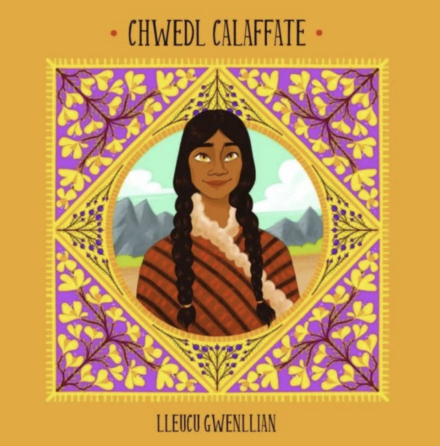
If you go to Patagonia, you will certainly be offered some Calafate fruit jam, and you are sure to see its beautiful golden flowers growing all over the pampas. Everyone, apparently, who eats the fruit, will be charmed to return to Patagonia – do you want to hear why?
Books for Children Under 7
This is definitely one of the most beautiful Welsh language books to be published in 2021 and it’s one of my personal favourites.
I’m thrilled with this publication, it’s really good – the story, the pictures – the whole lot. Well done Lleucu. According to her blog, Bethan Gwanas is also a fan of the book, and she knows better than most about what makes a good book.
I’m so pleased to see a story with an international dimension coming to market – It’d be great to see some more to be honest, especially if they are of the same high standard as Chwedl Calaffate.
The illustration is excellent. Now, there are a number of talented artists in Wales who do children’s books, but in my opinion, this is an example of some of the best. The warm colours perfectly convey the hardship of life on the but this is an example of the best in my opinion – the warm colours of orange, yellow and red, which convey the hardship of life on the prairie.
As is evident from the title, this is a legend, or fable, originally from Patagonia, which mentions the fruit of the Calaffate, and the sad story behind it. I wasn’t familiar with the tree, its fruit or the legend, I have to admit.
The legend comes from the saying “El que come Calafate siempre vuelve.” That is, those visiting who taste the fruit of the Calaffate, are sure to return one day. There’s something very romantic behind it, much like the idea of ‘hiraeth’ (longing) that we have in Wales – the powerful link between the people and the land.
There’s romance in the story too, which according to the author’s own words, resembles the story of Blodeuwedd. Both stories depict young couples who fall in love, but a love that is not meant to be. You can’t help but think it’s a shame that the older men didn’t just mind their business and let the young couples crack on.
I think this fable would be a good one to adapt as an animated short for television, if there was money to do so.
In addition to the story itself, we get a glossary, and some more information about the origins of the tale, and some details about the process of putting the book together. I don’t know about you, but I’m fascinated with little behind the scenes details like this.
Now there’s only one thing left to do – to make sure that I visit Patagonia one day, and to try the fruit of the calafate [berberis microphylla] for myself.

